Andharban Dark Jungle Trek
Destination
Pune
Duration
1 Days / 1 Nights
Difficulty
Moderate
Seats
Contact for details
About This Trip
Andharban is open all day. People sometimes treat this as a night trek as well, the only extra precaution being that they need to carry torches and be extra careful on the trail. However, for someone going for the first time, it is always recommended that they trek during the day, as it is easier to lose your way after nightfall, and one small wrong turn could mean that you wander into the Kundalika Valley. It is best to depart for Andharban early in the morning, timing the journey to reach the start point by 9 a.m.
The start point of the trek is about 200 meters away from Pimpri village, at a location called Independence Point near the Pimpri Dam. There is no specific marking for the start point, but the trail is visible. You can ask nearby villagers for directions if needed. A path winds through a broken chain-link fence. Here, trekkers need to pay a fee of Rs. 50 per person before embarking on the trek. There is no permanent counter as such, just a temporary shelter, but the fee is legitimate, and trekkers get a formal receipt acknowledging the charge paid.
The trail essentially maps a shallow U-shaped turn around the backwaters of the Bhira Dam in the Kundalika Valley. Despite being a continuous drop, the extreme humidity and slippery route make it slightly tough. It takes around 4-5 hours to cover the 13-kilometer trail.
The trail runs completely through a dense jungle and is far from any human habitation. Make sure you carry light snacks and enough water to last (at least 3 liters), as there are no sources of drinkable water along the route.
Being a jungle trek, Andharban offers views of flora and fauna, with several species of birds to be seen, such as the chaatak, the Malabar whistling thrush, dwarf kingfishers, and minivets, among several others. The Indian Giant Squirrel has been seen around the area, although sightings are rare.
The path continues along the top of a wall abutting the Pimpri dam for about a hundred meters, after which it turns right and enters an open area. You’ll see paddy fields on both sides of it. This road continues for about 200 meters before reaching two tall bushes. Turn right here. This point is easily recognizable because of a visible, well-made route and a signboard marking the start of the trail a few meters ahead on the right.
This trail continues straight for a while, with the Kundalika valley on the left and the mountains to the right. This is not yet the start of Andharban. The undergrowth slowly begins to grow dense as we go in deeper, although it is still easy to navigate. Through the course of the trek, we encounter three major streams of rivers, the first of which is reached at the end of this path after about an hour’s walking. This can sometimes be turbulent during the monsoons, and you might need ropes to cross it with.
The trail picks up on the opposite bank and continues for almost 1.5 km of a flat walk through a winding route before reaching another rivulet, after a sharp U-bend. This rivulet too tends to overflow. However, a cable has been provided at the crossing. After a slight ascent up into the hills (about 10 ft of climb), the trail winds into a dark forest, and it is here that Andharban truly begins.
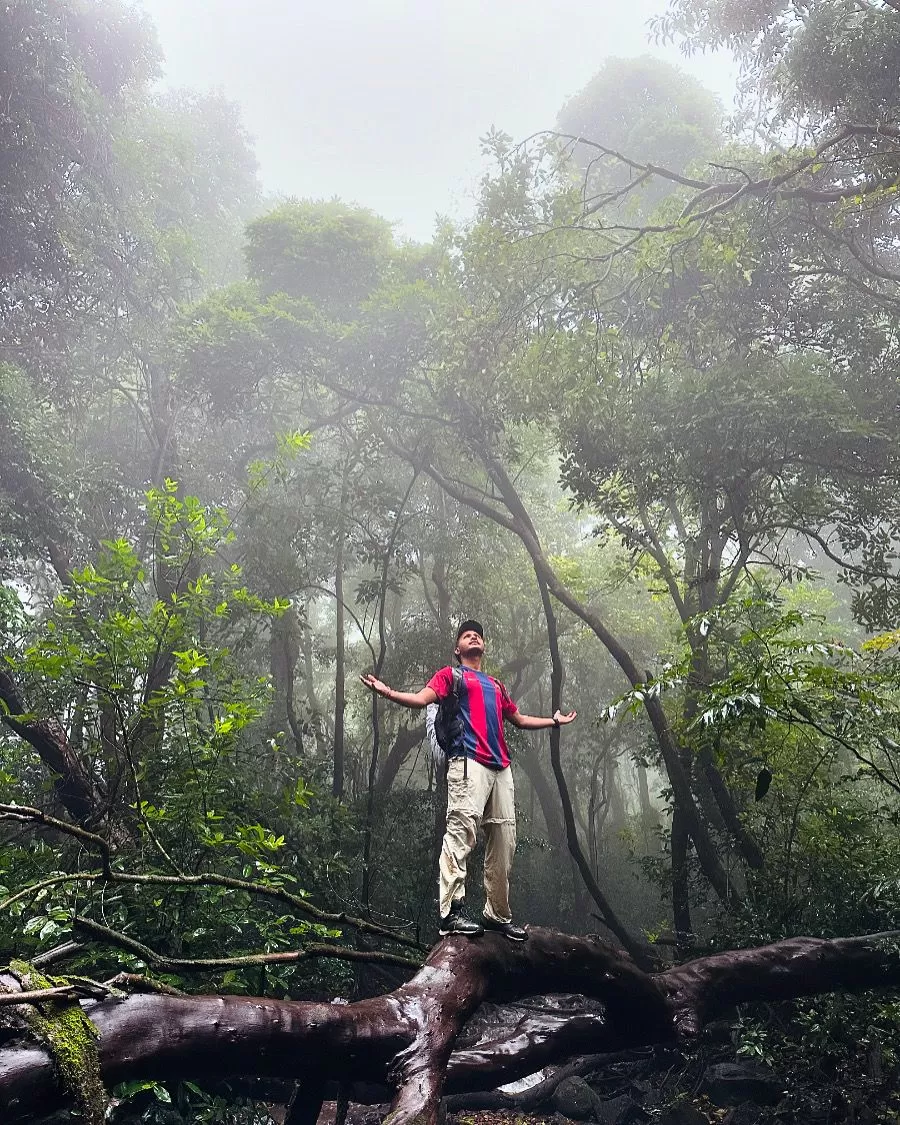
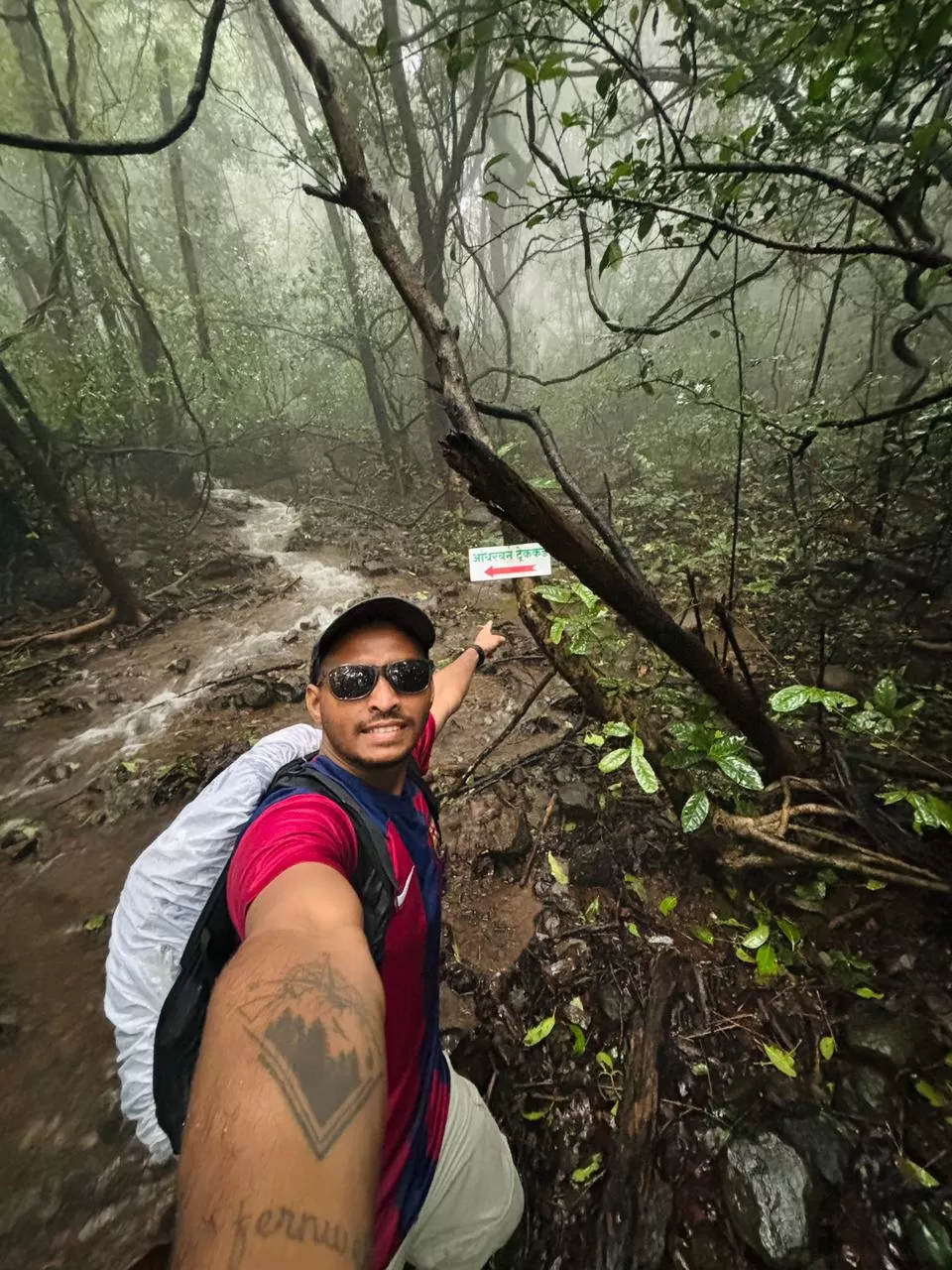
Although the forest can get quite dark, especially due to the presence of fog during the rains, the trail throughout is very clearly visible, with little chance of going awry. Trekkers should watch out for leeches. We suggest you wear full-sleeved or full-length clothes. There are markers set by previous travelers to mark paths to avoid. In several places, fallen tree logs have been placed horizontally across trails that need to be avoided.
The walk through the dense forest is one of a very gradual descent. It continues for almost three kilometers before climbing a small hill. Here, it opens into a wide, open plateau-like space. Plus Valley to the left provides a wonderful view. This is a good place to set up a temporary camp and have lunch. Alternatively, one could walk 5 more minutes to get to Hirdi, a small village nearby. Hirdi does not have too many options for dining, although bathroom facilities can be availed of here.
From Hirdi, the road turns right and leads downward into the valley. A gradual descent begins here. The easiest way to spot the route is that several slippery round stones are marking the trail. This descent continues for almost 2 km. The trail then opens into a wide plateau (people camp here for the night, sometimes, but it is preferable to walk ahead for better views and to keep a distance from the village).
From this point onwards, the road is again mostly flat, except now the backwaters of Bhira Dam can be seen to the left or front. This patch of the trail, although easy, is long. It ends at a wide river flowing across the trail. This river, although broad, is shallow and easy to cross even during the rainy season.
Past the river, the road continues straight onward, and, slowly, small huts and shops can be seen on the left side of the road. Walking straight on, the trail reaches Patnus village, and, ahead of it, Bhira village. Patnus has several lodges for staying overnight and/or changing into fresh clothes, as well as options for lunch (one small dhaba owned by ‘Kulkarni Kaka’ is recommended). The village is the end point for the trek, and also where the trekkers should ideally ask their vehicles to arrive for pickup.
Trekkers are recommended to begin the journey by 9 a.m. at the latest, reach Patnus by 3/4 p.m., and then drive back to Lonavala before nightfall. If you choose to stay overnight at Patnus, there are several lodges and rooms (costing Rs. 500 per person on average, including food), and even a few camping sites.
Andharban is open all year round, but the best time to visit would be during the monsoon and the post-monsoon period when dense fog settles down in the forest and everything is fresh and green. Although purely a descending trek throughout, Andharban manages to elevate the senses to a completely new level.
Trip Gallery
Get a glimpse of the experience waiting for you.
Detailed Itinerary
Day-by-day plan for a smooth and memorable journey.
🌳 Andharban – Into the Mystic Jungle
- 🕙 10:00PM : Departure from Dadar by private bus 🚌
- 🌙 Overnight journey – enjoy travel with music, fun & group bonding 🎶
- 🕙 10:00PM : Departure from Dadar by private bus 🚌
- 🌙 Overnight journey – enjoy travel with music, fun & group bonding 🎶
- 🌄 4:30AM : Reach base village (Pimpri / Independence Point)
- 🚿 4:45AM : Freshen up
- 🍽️ 5:00AM : Breakfast at base village
- 🧑🏫 5:15AM : Introduction & safety briefing by Trek Leader
- 🥾 5:30AM : Start Andharban Forest Trail trek
- 🌳 Dense Andharban “Dark Forest” trail
- 🌫️ Misty jungle paths & cloud-covered routes
- 🌄 Stunning views of Kundalika Valley
- 💧 Multiple waterfalls & flowing streams
- 🦋 Rich biodiversity & lush greenery
- 📸 Scenic viewpoints throughout the trail
- ⛰️ 10:30AM - 11:00AM : Reach end point (Bhira side)
- 🧘 11:30AM : Rest & relax
- 🍛 12:30PM : Lunch
- 🚌 02:30PM : Start return journey towards Mumbai
- 🏁 10:00PM : Reach Dadar & trek ends
Other Information
A walk through a living, breathing rainforest—Andharban is where mist, waterfalls, and dense jungle come together to create a surreal escape into nature’s wild and tranquil side.
What’s Included
- Travel arrangements – pickup and drop from the designated meeting point
- Breakfast
- Lunch (Veg & nonveg)
- Trek insurance coverage
- Experienced trek guide
- First aid support
- Entry fees (if applicable)
What’s Excluded
- Any expenses not specifically mentioned in the inclusions
- Personal expenses (such as shopping, additional food, etc.)
- Dinner during travel
- Any additional meals or beverages not listed in inclusions
- Costs arising due to unforeseen circumstances (weather conditions, delays, etc.)
Things To Carry
- Trekking shoes with good grip & quick-dry feature
- 2-3 liters of water (Carry in leakproof bottles)
- Extra pair of dry clothes & socks
- Dry snacks & energy bars (Avoid items that get soggy)
- Personal medicines (if any)
- Torch with extra batteries (Waterproof or in ziplock)
- Cap / Hat & sunglasses
- Full-sleeve quick-dry clothes (To protect from insects)
- A small backpack – no trolley bags please!
- Plastic bags / Ziplocks to keep electronics & valuables dry
- Trekking pole (optional but helpful on slippery trails)
Mode of Transport
Policies & Terms
Payment Policy
Cancellation Policy
Terms & Conditions
Related Trips
Explore more adventures you might love.